Cristoforo Colombo (t/n) - arte a bordo

Contenuto

Cristoforo Colombo (t/n) - arte a bordo
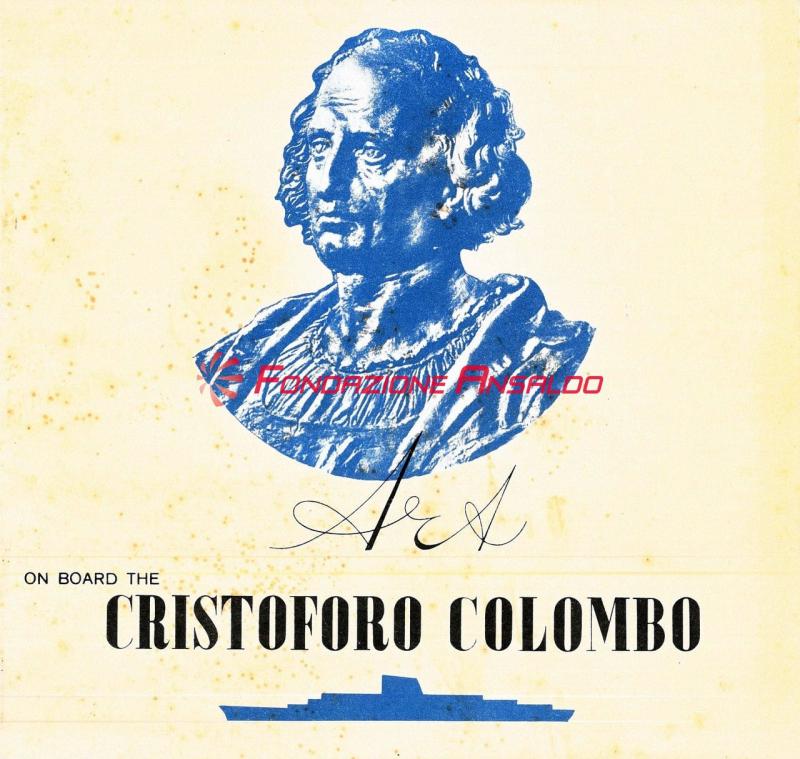
Titolo originale
"Art on board the Cristoforo Colombo"
Tipologia
Opuscolo a stampa
Descrizione

Opuscolo in lingua inglese a cura della società Italia di Navigazione relativo alle opere d'arte presenti a bordo del Cristoforo Colombo

Data testuale
Senza data ma 1955
Consistenza
1 opuscolo (pp. non numerate 20)
Stato di conservazione
Discreto
Soggetto produttore
Maurizio Dante (1962 - ***)
Identificativo
MD.000125
contenuto
ON BOARD THE

(RISTOFORO COLOMBO
calice

fe
3 x Fonpazione FnsaLoo


_

(D» “Cristoforo Colombo” is the founh of the new liners consiructed in the postwar
period to potentiate the fleet of Italian Line. Like the “Andrea Doria”. she is fumished
in a style hovering in elegance between the splendid and the unobtrusive, enhanced by a
rich selection of works of art

Painters and sculptors have vied with each other in their adormment of the public rooms in
the three classes aboard. and, aided by the painstaking craftmanship of artisans, have prodigated
to produce the innermost treasures of their fantasy. The fascinating theme of the voyage to
the New World inspires many of the works of art aboard the ‘ Cristoforo Colombo”, which ore
to be found in È the public rooms, from the First Class vestibule to the upper decks. and

mne Pensare Arsane

The main lounge is predominantly Columbian in its decorative theme, with the coat-of-arms
of the Great Explorer reproduced in morquetry in the centre of the aft wall, opposite which
is a black and white tapestry woven by Ponis of Genoa on designs by Enrico Ciuti, symbolizing the
adventurous ocean crossing leading to the discovery of America. Another composition by Ciuti,
inspired by ancient manuscripts, and fired on panels of ash, covers a complete wall of the
adjacent bor, designed by the orchitect Pulitzer.

In the ballroom there are three huge silver-plated copper bas-relies by the sculptor Romano Rui,
which have as their theme the voyage of Marco Polo and constitute a succession of episodes
in miniature, designed with microscopic finesse. From the West to the unknown Orient, the
epic ocean crossing and the most memorable overland joumey of all times are thus harmoniously
commemorated side by side in these three bos-reliefs together with the copper medallion ot
Columbus. Completing: the decor of. the locale are six large mirrors enclosed in original. glass
and enamel frames, reproducing the Italian "Maschere". by Felicita Frai.

The decor of the vast elegant First Closs dining room, designed by Guglielmo Ulrich, is
in predominantly light colors which graciously harmonize with the wall adornments and
furnishings. On the walls are eight cil paintings by Adriano di Spilimbergo. Four are luminous
landscapes and four delightful flower pieces. Another landscape by the same pointer is
admirobly situated in the small private dining room, while in the childrens dining room
Ettore Paganini has executed on illuminated panels a number of impish puppets. supplemented
with a gay painting by Aldo Salvadori.

The four magnificent luxury suites were each designed by a different architect, Aristide Chiavola,
Luigi Carlo Daneri, Carlo Pouchain and Nino Zoncada, and contain paintings by Libero
Verzetti, Renata Cuneo, Giovanni Patrone, Federico Morgante and Oscar Saccarotti, whose
diverse themes heighten the effect of the striking interior decor.

The architect Nino Zoncada also designed the childrens dining rooms in First and Cabin.
Oscar. Saccarottfi f£ °F; to the pda] th ANAAO a goily-colored
È
soning cepicingna$. Im CUNLIFIZIINE der ione poning
vivaciously executed* by Giovanni Mecioli
The First Class foyer was designed by Carlo Pouchain. Its ceiling. appropriately decorative in
design and coler. is the work of the painter Federico Morgante. In the center panel of the
moin staircase leading to the foyer is the coat-otarms of Columbus. The bronzes on the
railings were engraved by the sculptor Orazio Martelli.
The ceramics of Romano Rui adorm the pastel-colored walls of the winter garden. At the
entrance to the observation lounge ate two original panels in raised copper by Maiocchi.
Noteworthy in this lounge is a bronze statue created by Renata Cuneo and the artistic
Venetian glass panels decorating the walls of the room. Four still life paintings and three
landscapes by Roberto Aloi give a distinctive tone to the First Class reading and writing
rooms, designed by the architects. Alessandri and Gottardi, who also created the observation
lounge and the card room. The paintings in the reading room are effectively. supplemented
by a decorative panel in enamelled copper by Paolo De Poli.

Of singular decorative effect is a large mural painting depicting classic dancers, by Felicita
Frai, occupying the entire aft wall of the Cabin Class ballroom. Ceramics by Toni Furlan
and enamelled bronze decorations by Paolo De Poli are situated in the Cabin Class bar
and card room. This group of public rooms was designed by the architect Matteo Longoni,
as was clso the Cabin Class dining room, whose murals depict the mysteries of marine
depths. where broken amphorae and maimed ancient statuary are exquisitely rendered by
Dino Predonzani. Of praiseworthy mention also in Cabin Class are decorations by Roberto
Aloi in the shop, by Renata Cuneo on the stoircase and by Afro and Leoncillo in the
Swimming Pool Veranda.

The accent on decorative art is not lacking in Tourist Class, where the architect Angelo Crippa
designed the spacious and airy dining room, the foyer and the staircase. Two large murals
by Ugo Rossi decorate the panels of the dining room: one depicting country scenes, the

other representilto a the region of Liguria inzibe days of Columbus.

Notzuonhy ine palicINTZHINEi ANSIMA: Mario Tevaroto,

are the a glass panels by Tevarotto and ceramics by Lucio Fontana. The same
architects designed the Tourist Closs reading. writing and card rooms. Other notable works
of art in Tourist Class are the decorations by Lauro Mannucci in the Officers” dining room
and the bas-reliefs in the Captain's and Chief Engineers quarters. created by the sculptor
Lorenzo Garaventa.

Another facet of the Columbion theme running throughout the ship is to be found in the
vessels chapel. designed in baroque style by Luigi Segala. Historic episodes of the life
of Columbus are depicted in the two paintings, one of which shows the Explorers house, the
other, beneath the altar, illustrates the blessing ot the three caravels by the Archbishop of
Seville in the presence of Queen Isabel of Spain, prior to their departure for the New World.
These paintings are by Lino Schenal, who also executed the fourteen pictures of the Stations
of the Cross and the Madonna of the Sea.

LI

DA SEDE


This topestiy in block and white, woven by Alberto Ponis on designs by Enrico Ciuti in the
First Class lounge, symbolically represents the first adventurous ocean crossing to the New World


The silversplated copper basreliefs, sculptured by Romano Rui,
have as their theme the voyage of Marco Polo.


The succession of episodes in miniature which bring to life
with postic fantasy a fabulous werld, find coherent concatenation
in the unique style of these bassrliefs by Maiocchi

The enchanting bronze statue in the
observation lounge is by Penota
Cuneo, one of Italy's most promising

sculpiresses


The six large minors in the First Class bellroom are originally enclosed in decorative gloss and enamel frames by Felicita
Fral. who has deftly rendered the Italion “Moschere” in her own inimitable. sile


2 ra

Xx Fonpazione ANsALDO

The two pointings in the First Class
reading room, executed by the
vigorous cond. inimitable brush of
Roberto Aloî, seem to couple together
the alliance between reality and the
mystery of noture


One of the eight il pointings by Adriano di Spilimbergo
decorating the First Closs dining room. The landscopes by this
pointer convey in simple language the best traditions of
landscape peinting.


The “emusement park” motif in
the First Class. children's room
has been gaily depicted by
Oscar Saccarotti in a riot of
colors interveaving their woy
through mery-go-rounds, sharp
shooting stands and. festoons.


The puppets in multi-colored enomel, oc-
cupying specially illuminated panels in the
First Class children's dining room, are by
the painter Ettore Pagonini


This large muraì decoration by Felicita Fral, occupies the entire
aft wall of the Cabin Class ballroom. The motif of classic
dances is of singular decorative effect with its. predominating
chromatic accent highlighting the many hues of red and gold.

1

ARSALDO:


The continuative motif of the four paintings by Dino Predonzani
in the Cabin Closs dining room is a fantasy of marine depths.
of a werld abstract and remote, gathering between its nets
and clinging sea-weed ancient

amphorae and torsos of
maimed. statuary.

Earthenware by Toni Furlan adoms the Cabin Class bar. OI
a heow. dullred, they ocquire a singular decorative elfect in
the brilliancy of their enamels


this

ss, where

Tourist Clos
I by the pointer Angelo Tevorotto

its omai

5
d
e
è
È
8
$

2


mento! mission.

absolves

impesingly


the altar

Above

depicted by Lino Schenol.


On the foot-pace of the altor the painter has represented the blessing of the three Columbian
caravels by the Cardinal Archbishop of Seville, in the presence of Queen Isabel of Spain.

N

3 x Fanvazione FAnsaLoo

Edited by “ITALIA “ Soc. di Nav. - Genoa. 4-1955 - 6.000

fa
(SI Fonvazione ANsALDO

"ITALIA" è» SOCIETÀ DI NAVIGAZIONE e GENOA
extracted text
ON BOARD THE

(RISTOFORO COLOMBO
calice

fe
3 x Fonpazione FnsaLoo


_

(D» “Cristoforo Colombo” is the founh of the new liners consiructed in the postwar
period to potentiate the fleet of Italian Line. Like the “Andrea Doria”. she is fumished
in a style hovering in elegance between the splendid and the unobtrusive, enhanced by a
rich selection of works of art

Painters and sculptors have vied with each other in their adormment of the public rooms in
the three classes aboard. and, aided by the painstaking craftmanship of artisans, have prodigated
to produce the innermost treasures of their fantasy. The fascinating theme of the voyage to
the New World inspires many of the works of art aboard the ‘ Cristoforo Colombo”, which ore
to be found in È the public rooms, from the First Class vestibule to the upper decks. and

mne Pensare Arsane

The main lounge is predominantly Columbian in its decorative theme, with the coat-of-arms
of the Great Explorer reproduced in morquetry in the centre of the aft wall, opposite which
is a black and white tapestry woven by Ponis of Genoa on designs by Enrico Ciuti, symbolizing the
adventurous ocean crossing leading to the discovery of America. Another composition by Ciuti,
inspired by ancient manuscripts, and fired on panels of ash, covers a complete wall of the
adjacent bor, designed by the orchitect Pulitzer.

In the ballroom there are three huge silver-plated copper bas-relies by the sculptor Romano Rui,
which have as their theme the voyage of Marco Polo and constitute a succession of episodes
in miniature, designed with microscopic finesse. From the West to the unknown Orient, the
epic ocean crossing and the most memorable overland joumey of all times are thus harmoniously
commemorated side by side in these three bos-reliefs together with the copper medallion ot
Columbus. Completing: the decor of. the locale are six large mirrors enclosed in original. glass
and enamel frames, reproducing the Italian "Maschere". by Felicita Frai.

The decor of the vast elegant First Closs dining room, designed by Guglielmo Ulrich, is
in predominantly light colors which graciously harmonize with the wall adornments and
furnishings. On the walls are eight cil paintings by Adriano di Spilimbergo. Four are luminous
landscapes and four delightful flower pieces. Another landscape by the same pointer is
admirobly situated in the small private dining room, while in the childrens dining room
Ettore Paganini has executed on illuminated panels a number of impish puppets. supplemented
with a gay painting by Aldo Salvadori.

The four magnificent luxury suites were each designed by a different architect, Aristide Chiavola,
Luigi Carlo Daneri, Carlo Pouchain and Nino Zoncada, and contain paintings by Libero
Verzetti, Renata Cuneo, Giovanni Patrone, Federico Morgante and Oscar Saccarotti, whose
diverse themes heighten the effect of the striking interior decor.

The architect Nino Zoncada also designed the childrens dining rooms in First and Cabin.
Oscar. Saccarottfi f£ °F; to the pda] th ANAAO a goily-colored
È
soning cepicingna$. Im CUNLIFIZIINE der ione poning
vivaciously executed* by Giovanni Mecioli
The First Class foyer was designed by Carlo Pouchain. Its ceiling. appropriately decorative in
design and coler. is the work of the painter Federico Morgante. In the center panel of the
moin staircase leading to the foyer is the coat-otarms of Columbus. The bronzes on the
railings were engraved by the sculptor Orazio Martelli.
The ceramics of Romano Rui adorm the pastel-colored walls of the winter garden. At the
entrance to the observation lounge ate two original panels in raised copper by Maiocchi.
Noteworthy in this lounge is a bronze statue created by Renata Cuneo and the artistic
Venetian glass panels decorating the walls of the room. Four still life paintings and three
landscapes by Roberto Aloi give a distinctive tone to the First Class reading and writing
rooms, designed by the architects. Alessandri and Gottardi, who also created the observation
lounge and the card room. The paintings in the reading room are effectively. supplemented
by a decorative panel in enamelled copper by Paolo De Poli.

Of singular decorative effect is a large mural painting depicting classic dancers, by Felicita
Frai, occupying the entire aft wall of the Cabin Class ballroom. Ceramics by Toni Furlan
and enamelled bronze decorations by Paolo De Poli are situated in the Cabin Class bar
and card room. This group of public rooms was designed by the architect Matteo Longoni,
as was clso the Cabin Class dining room, whose murals depict the mysteries of marine
depths. where broken amphorae and maimed ancient statuary are exquisitely rendered by
Dino Predonzani. Of praiseworthy mention also in Cabin Class are decorations by Roberto
Aloi in the shop, by Renata Cuneo on the stoircase and by Afro and Leoncillo in the
Swimming Pool Veranda.

The accent on decorative art is not lacking in Tourist Class, where the architect Angelo Crippa
designed the spacious and airy dining room, the foyer and the staircase. Two large murals
by Ugo Rossi decorate the panels of the dining room: one depicting country scenes, the

other representilto a the region of Liguria inzibe days of Columbus.

Notzuonhy ine palicINTZHINEi ANSIMA: Mario Tevaroto,

are the a glass panels by Tevarotto and ceramics by Lucio Fontana. The same
architects designed the Tourist Closs reading. writing and card rooms. Other notable works
of art in Tourist Class are the decorations by Lauro Mannucci in the Officers” dining room
and the bas-reliefs in the Captain's and Chief Engineers quarters. created by the sculptor
Lorenzo Garaventa.

Another facet of the Columbion theme running throughout the ship is to be found in the
vessels chapel. designed in baroque style by Luigi Segala. Historic episodes of the life
of Columbus are depicted in the two paintings, one of which shows the Explorers house, the
other, beneath the altar, illustrates the blessing ot the three caravels by the Archbishop of
Seville in the presence of Queen Isabel of Spain, prior to their departure for the New World.
These paintings are by Lino Schenal, who also executed the fourteen pictures of the Stations
of the Cross and the Madonna of the Sea.

LI

DA SEDE


This topestiy in block and white, woven by Alberto Ponis on designs by Enrico Ciuti in the
First Class lounge, symbolically represents the first adventurous ocean crossing to the New World


The silversplated copper basreliefs, sculptured by Romano Rui,
have as their theme the voyage of Marco Polo.


The succession of episodes in miniature which bring to life
with postic fantasy a fabulous werld, find coherent concatenation
in the unique style of these bassrliefs by Maiocchi

The enchanting bronze statue in the
observation lounge is by Penota
Cuneo, one of Italy's most promising

sculpiresses


The six large minors in the First Class bellroom are originally enclosed in decorative gloss and enamel frames by Felicita
Fral. who has deftly rendered the Italion “Moschere” in her own inimitable. sile


2 ra

Xx Fonpazione ANsALDO

The two pointings in the First Class
reading room, executed by the
vigorous cond. inimitable brush of
Roberto Aloî, seem to couple together
the alliance between reality and the
mystery of noture


One of the eight il pointings by Adriano di Spilimbergo
decorating the First Closs dining room. The landscopes by this
pointer convey in simple language the best traditions of
landscape peinting.


The “emusement park” motif in
the First Class. children's room
has been gaily depicted by
Oscar Saccarotti in a riot of
colors interveaving their woy
through mery-go-rounds, sharp
shooting stands and. festoons.


The puppets in multi-colored enomel, oc-
cupying specially illuminated panels in the
First Class children's dining room, are by
the painter Ettore Pagonini


This large muraì decoration by Felicita Fral, occupies the entire
aft wall of the Cabin Class ballroom. The motif of classic
dances is of singular decorative effect with its. predominating
chromatic accent highlighting the many hues of red and gold.

1

ARSALDO:


The continuative motif of the four paintings by Dino Predonzani
in the Cabin Closs dining room is a fantasy of marine depths.
of a werld abstract and remote, gathering between its nets
and clinging sea-weed ancient

amphorae and torsos of
maimed. statuary.

Earthenware by Toni Furlan adoms the Cabin Class bar. OI
a heow. dullred, they ocquire a singular decorative elfect in
the brilliancy of their enamels


this

ss, where

Tourist Clos
I by the pointer Angelo Tevorotto

its omai

5
d
e
è
È
8
$

2


mento! mission.

absolves

impesingly


the altar

Above

depicted by Lino Schenol.


On the foot-pace of the altor the painter has represented the blessing of the three Columbian
caravels by the Cardinal Archbishop of Seville, in the presence of Queen Isabel of Spain.

N

3 x Fanvazione FAnsaLoo

Edited by “ITALIA “ Soc. di Nav. - Genoa. 4-1955 - 6.000

fa
(SI Fonvazione ANsALDO

"ITALIA" è» SOCIETÀ DI NAVIGAZIONE e GENOA

Position: 293 (67 views)