Ansaldo - Produzione aeronautica - SVA

Contenuto

Ansaldo - Produzione aeronautica - SVA
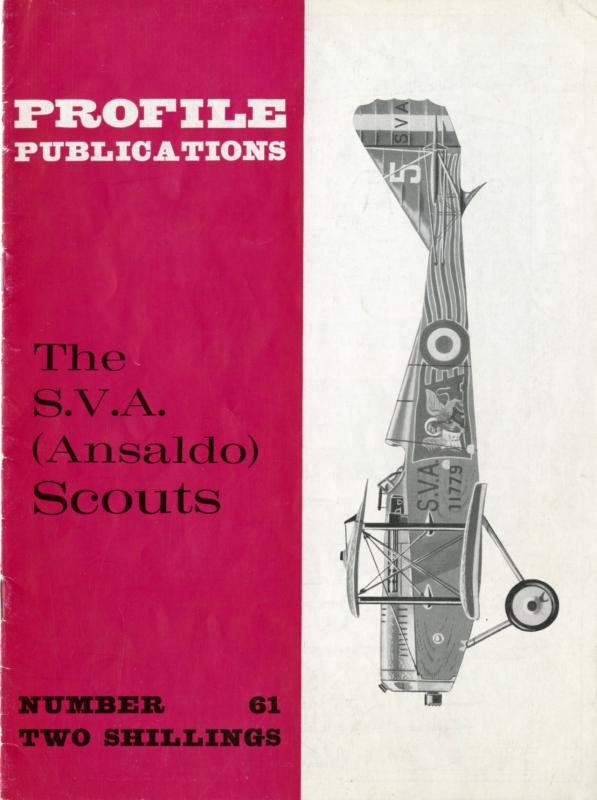
Titolo originale
"The S.V.A. (Ansaldo) Scouts"
Tipologia
Opuscolo a stampa
Descrizione

Opuscolo in lingua inglese edito dalla società inglese Profile pubblications e scritto da Gianni Cattaneo sulla produzione Ansaldo di aeroplani SVA e le loro caratteristiche tecniche. 

Data testuale
1966
Consistenza
1 opuscolo (cc. 12)
Stato di conservazione
Buono
Identificativo
OP.000014
Note
Ceduto il 28/2/1991 dall'ing. Giorgio Bertagnolli
contenuto


Lion of St. Mark
emblem of 87
Sq.

, serial 11779, of th
lia Ricognizione

Serenissima”, Aeronautica
tare, based at S. Pelagio, Ital
in July 1918.


(© JAMES GOULDING


Scouts


The Sw.
Here, an S.V.A.5 climbs st
the Fokker DIVIL

On the 3rd March 1917, over the Italian airfield of
Grosseto, the prototype of an aireraît that to
mark a significant step forward by the Italian aviation
ira i ra
machine, the then Flight Sergeant M. Stoppani, was
immediately enthusiastic about the power, handi
characteristics and speed of the delicate S.V.A.; am
his response ed in the years that followed by
the many pilots who were to ride the sleek biplane
to fame as one of the best all-purpose aircraft of
W.W.I, and the reliable instrument of many memor-
able exploits in the skies of the world in the years of
peace. The S.V.A. was to continue in useful service
into the 19305, and some significant features of its
design can be traced in machines which saw wide-
PRI

Until 1916 the products of the Italian aircraft
industry were not generally distinguished by any grea
originality of design or performance. There were a few
notable exceptions, such as the Caproni bomber
series; but in the main the industry was occupied with
licence production of foreign designs, notably those of
French origin. It was int ation that the
S.V.A. was born, the brain-child of two brilliant
Technical Officers of the Direzione Tecnica dell
Aeronautica Militare (Military Aviation Technical
Directory) of Turin, R. Verduzio and U. Savoia. The
most significant facet of the design was that it marked
a progression from empirical experimentation to
systematic estimates; for the first time, actual calcula-
tions of the foresecable aerodynamic and structural
characteristics of the projected aircraft. were made
from an early design stage. This was obviously an
advance of the greatest importance to the develop
ment of aviation techniques in Italy

The small design team was completed by Ing. C.
Rosatelli, later to win international recognition as the
long-time Chief Designer for the Fiat company, and
Ing. G. Brezzi. The final proposals for the new type,
then designated S.V., were laid before the directors of


A series were (he most significa Halian designs of W.W.I, and were the forerunners of several historic airerafi of later years
feeply from take-off: climb characteristics of the I.F.-en he S.E.Sa and


gined variants were superior to both {i
CEhoro: Col. Cesar Milani)


Soc. Ansaldo of Genoa, an engineering and manu-
facturing concern comparable in national prominence
to Vickers in England Krupps in Germany.
However, well aiare of he potential of the promising
design, the D.T.A.M. decided to assume overall ci
Gala vbok cotton io a
began as a private venture became a Government
project of the widest scope. With what were, in effect,
unlimited Government funds at their disposal, ener-
getic direction, and full official co-operation, Ansaldo
offered the best prospects for the development of a
modern, efiient aeronautica! section. Starting from
the company set up a new factory at Borzoli
near Tp in November 1916, designated Cantiere /.
A widespread expansion was ni Cantiere 2
with an airfield adjacent, Bolzaneto: in
Sa isa aa
ant at Turin was taken over as Cantiere 3; a plant
feto
La Spezia, and in the spring of 1918 the Company
Pomilio was absorbed as Cantiere 5.
As stated above, the prototype flew for the first
time in March 1917; and in the months that followed
the newly-designated S.V.A. (Savoia-Verduzio-An-
saldo) was subjected to a rigorous test programme in
Italy and abroad. The designers had intended to


n S.V.A.4 of the 87° Sq. Ric. “La Serenissima” on a front-line
Girpeld a 19180 Note Si bon cis gn the fuselage sides under
7 Photo: Col. Cesar Milani)


The S.V.A.4 of one of Italy's outstanding reconnaissance pilots,

create one of the fastest fighter aircraft of the time
with exceptional range capability; i was conceived as
a fighter, and there is no doubt that its subsequent

assignment to the scout/reconnaissance-bomber ròle


The reasons for its rejection as a pure fighter are
somewhat obscure; but it seems that undue weight

was given to its lacking the extreme manceuvrability
ch a


appreciate the cvantages of its superior range and
speed. The S.V.A. prototype was in fact 30 m.p.h
faster than any machine of either side in service on the
Italian Front at that time; and it was this speed,
combined with load-carrying capacity,


outstanding fast reconnaissance aircraft. It could dis-
pense with fighter escort, accept combat with fighters
on reasonably equal terms, and break off combat at
will by utilising its superior speed and good climb


istic
Tea its lo career the S.V.A. underwent many
modifications and appeared in numerous sub-types,
the exact differentiation of which is often obscure and
contradictory. The prototype followed by a ver-
sion slightly modified in weight and installations,
designated S.V.A.4. This gave place to the first major
production S. This single-seat


variant, the S.V.A
reconnaissance machine was characterised by the
peculiar arrangement of wing struts, the Warren truss,
that was to be the hall-mark of later Ansaldo machines
before passing on to the Fiat biplane fighters designed
by Rosatelli in the early 1930s. A structural descrip-
tion of the S.V.A.S is thus generally pertinent to all
later series except in particular modifications which
will be cited below.

THE S.V.A. DESCRIBED
The structure of the S.V.A. presents an example of
skilful engineering intended to ensure speed, sim-
pliciy and economy during production. It was a
clean-contoured biplane of unequal span, with a long,
slim fuselage of simple and robust construction. The
two upper wing panels met over the fuselage centre-
line, while port and starboard lower wings were
attached to the fuselage at the lower longerons. Both
wings were of conventional two-spar and rib con-
struction, but the airfoil was unusually thin; at high
speeds the trailing edge tended to flatten out, decreas-
ing drag. In this manner it was possible to achieve a

4


Captain Natale Palli, taxis for take-


ff. (Photo: Col. Cesar Milani)

An operational. Note that the starboard machine gun has
been removed; this was often done when reconnaissance cameras
were carried (Photo: Col. Cesar Milani)

An SV.A.A with modified windscreen. (Photo: the author)

Tie S.V.AS prototype; notice the different w Indsergen strle and
the unvarnished finish. (Photo: Imperial War Museum)


mild “flap” effect at low airspeeds, with a bonus in
heavy-load take-off and landing characteristics.
Unbalanced ailerons were fitted in the upper wing
only. Interplane bracing was in the form of stream-
lined steel-tube struts in the Warren truss pattern,
absorbing all lift and landing stresses. Each strut
was wire-braced within itsell' to preserve incidence but
as no bracing between bays. The most unusual
ov n


section, from rectangular in the nose to triangular
behind the it. The basic fuselage structure w
simple rt of wooden longerons and struts,
to which a thin, flat plywood covering was applied
Upper longerons were conventional in form, but
lower members were brought together just behind the
cockpit and spliced to a single longeron which con-
tinued aft to the sternpost. At the expense of intro-
ducing a small amount of tail flexibility, a i

weight and improved streamlining were thus achieved
quite simply.

The upper fuselage deck forward of the cockpit
consisted of a louvered sheet aluminium cowling, and
the exhaust from the six.
engine was led out through collectors TA ‘short stacks
on the right-hand side. A large stamped-steel girder-
type fitting bolted near the end of the fuselage served
to stiffen the body and to carry the tailskid, which was
a steel leaf-spring. The main undercarriage was a
simple steel tube structure attached ddl to the
longerons; it carried a full axle sprung on rubber
shock cord. The empennage had an unbalanced mov-
able surface; the stabiliser could be adjusted on the
ground depending on equipment installed and could
be of wood or metal tube construction. Normal
armament consisted of two Vickers guns mounted
externally on either side of the cowling, just forward
of the cockpit, and synchronised for firing through the
propeller disc. Sometimes only one gun was carried;
immediately behind the fuel tank, placed on the rear
of the engine, were the two photo-reconnaissance
cameras. Instrumentation usually comprised r.p.i
counter, oil and fuel pressure gauge, starting magneto,
tank pressure switch, air pump, carburettor controi
and trimming control. The engine, the reliable water-
cooled S.P.A. 6A, developed 205 h.p. at 1,600 r.p.m.
(220 h.p. on later series) and gave a comfortable
maximum speed of 143 m.p.h.


DEVELOPMENT AND PRODUCTION
The S.V.A. was quickly ordered into quantity pro-
duction, which commenced in the autumn of 1917;
and by the close of the year 65 machines had been
built. Apart from normal series production, Cantiere 3
produced some experimental variants, principally to
test various engine installations. Excellent results were
obtained by the adoption of {he Isotta-Fraschini IF.

250 h.p.; speed in level flight reached 149 m.p.h.,
dini to 10,000 ft. was cut to seven minutes, and to

13,500 ft. a time of ten minutes was recorded. It will
be noted that these performance figures are substanti-
ally better than those achieved by two much more
widely-hailed aircraft of the period, the S.E.5a and the
Fokker D.VII. These results were confirmed during
the official test held at Taliedo, near Milan by the
test-pilot Cattaneo; these led in the summer of 1918
to the standardisation of this engine for the two-seater
version of the S.V.A. Another engine tested was the
Lorraine-Dietrich of 200 h.p., but this project was
abandoned owing to the negligible improvement over
the S.P.A. powerplant. It was at about this time that
a certain amount of licence production was estab-
lished; among others, the AER factory at Orbassano
produced a spe ant with reduced span and wing
area designated . 3 ridotto” (reduced). Some
were issued in the spring of 1918 to second-line units


An S.V.A.4 on the Italian Front, summer 1918.
(Photo: via the author)

f Ata


Rear and side views of the S.V.A.S: the Warren truss strut layout îs very apparent, and invites immediate comparison with the Fiat
PI

biplane fighters of the 1930.

tos: Col. Cesar Milani)


View of the S.V.A.10, showing
deeper conling of the 1.F. V6
powerplan

Photo: Col. Cesar Milani)


lefending cities in North-
ern Italy and a few were
employed by reconnais-
sance units. By this time
the exceptional qualities
of the aircraft had once
again been demonstrated on two flights, undertaken in
August and September 1918 by the prototype, to
ertain the exact range


as apabilities of the S.V.A.
Tie
consisted of a round trip non-stop between Turin
Udine and Turin, a distance of some 600 miles. The
second, with Lombard at the controls, was a non-stop
flight along the route Malpensa-Foggia-Bologna,
approximately 900 miles.

THE S.V.A. IN SERVICE
The S.V.A. began its strategic reconnaissance and
light bombing duties in February 1918. Special
lezioni (sections) were formed and attached directly
to each Army Headquarters. The first offensive sortie
took place on 29th February, with the bombing of
Bolzano and Innsbruck railway stations by four air-
craft of the /° Sezione, carrying small bombs in place
of their cameras; light bombs were slung on the
fuselage sides in special clips. The 320-mile flight
necessitated two crossings of the Alps, at 13,000 ft.
outward bound and 16,000 ft. on the return trip. Over
the target the S.V.A.s descended to 1,000 ft. and
bombing and strafing runs over the buildings and
Is round the depot gained considerable


is mission is typical of the hard conditions on the
in Front, where terrain was extremely rugged and
ded long flights over enemy-held terri-
S.V.A. was thus particularly welcome,
satisfying the long-standing requirement for a fast,
long-range scout a light bomber relying on speed
and its own armament for protection. The S.V.

became the most precious medium for gathering
intelligence during the preparation of the big offen-
sives of the last six months of 1918, before the final


important sorties in the spring of 1918 were carried
out by the newly-formed 87° Squadriglia, which took

Interesting view of 87° Sq. SV.


Captain Gino Allegri oses with an S.V.A. Capt. Allegri was one

s, and took part in the Vienna raid
I August (Photo: via Col. Cesar Milani)
both its style of “La Serenissima” and îts “Lion of
St. Mark” emblem from the city of Venice; this unit
was directly attached to Army Supreme Headquarters.
One memorable flight was undertaken on 2ist May
1918 by two S.V.A.5e of this squadron, piloted by
ASI rio
Ghedi, near Brescia, they crossed the Alps, flew over
the Rhine valley and Lake Constance, and secured
many reconnaissance photographs of the important
industrial towns of Bregenz, Lindau and Fried-
richshafen. They returned to base after four hours in
the air, covering 430 miles of almost exclusively
enemy-held territory.

Other strategic missions performed in this period by
the aircraft of the 87° Squadriglia included flights over
Cervignano, Monfalcone, Trieste, Adelsberg, Ober-
laibach and Lubiana. Important rail depots were
photographed almost daily, and a complete picture of
enemy supply and reinforcement movements was built
up in this way. Equally important were the flights

f the Italian Air Force's ace


A.5s on a forward airfield. The aîrerafi in the foreground carries three bomb clips on the port side.
to

Col. Cesar Milani)


in the (probably spurious) markings of th
note insirumentation and twin auxiliary petrol tanks
wing centre-section (Photo: the author


carried out by Capt. N. Palli over the Adriatic coast.
Leaving Brindisi on 16th May, Palli flew over Skutari
and Durazzo, taking photographs and returning to
base after a flight of 430 miles, 200 of which were over
the sea and 220 over enemy territory. On Ist June he
took off from Jesi, flew over Zara, Sebeniko and
Spalato, and returned after 5 hours 45 minutes in the
air; during that time Palli had flown 600 miles, 200
miles over the sea and 250 miles over occupied terri-
tory. For a single-engined, single seat aircraft of that
period this was a remarkable performance.

The High Command of the Aviazione Militare was
not slow to recognise the excellence of the S.V.A. and
production rapidly gained momentum. The 65
machines built in 1917 were followed in 1918 by 1,183,
thus making the S.V.A. the second most numerous


Isoti ‘hini - engined
S.V.A. on de in an Italian
museum's aeronautical coll
The erenissima”
emblem Is thought to
the case of this


(Photo: Col. Cesar Milani)

type built by the Italian
industry during W.W.I
the period 1915-18 ea
industry manufactured a
grandtotalof 11,956aircraft;382 in 1915, 1,225 in 1916,
3,861 in 1917 and 6,488 in 1918. Besides the S.V.A.
the types built in large numbers were the Pomilio P
(1,616 a/c), the Nieuport 80 HP (739 a/c), the Hanriot
HD.1 (831 a/c), the Caproni Ca 3 (250 a/c), the
Macchi M.S (344 a/c), the Saml (657 a/c), the Farman
(1,105 a/c) and the Aviatik (568 a/c).
From experience gained during these first few
months of operations and the confirmation of the
great development potential of the airframe, it was
possible to produce two derivations within a short
Patio Both were two-seaters; the S.V.A.9, powered
y the well-tried S.P.A. 6A engine, was used primarily
for training duties, while the S.V.A.10 was another
d light bombing machine. Powered
a-Fraschini V6, the S.V.A.10 was armed
with one fixed gun on the nose and a flexible Lewis
gun in the rear cockpit, manned by the observer.
Reconnaissance units played an important part during
the bitter fighting on the Piave River in June 1918,
giving the Italian Command a constant photographic
record of the rapidly -changing tuation at the Front.
V.A.s were particularly active between 15th and 25th
June. In this period, large quantities of propaganda
leaflets were dropped on the Austrian lines, repeating
on a large scale the tactics used in the offensive of
1916. The redoubtable Capt. Palli made an extremely
hazardous reconnaissance flight at this time over the
well-defended harbour of Pola, flying S.V.A. serial
1170. Despite a heavy and continuous anti-aircraft
barrage, Palli secured a magnificent series of photo-
e - Sem 3,000 ft. which enabled seventy Italian
io drop more than five tons of bombs on the
Fa FO during a raid some days later.


ngined S.V.A.5 on floats. About ff of these machines were constructed by the Ansaldo plant at La Spezie

oto Col Cesar Milani)


An unvarnished S.V.A.S în flight. This illustration shows the
unusual taper of the fuselage to good effect. (Photo: the author)

With the failure of the Austrian push, the way was
open for the final stages of the campaign which led in
November 1918 to the Armistice. It is relevant at this
point to mention the strength of the opposing air
forces on the Italian Front in mid-1918, and the
importance of the part they played in the overall
picture. The Italian air component disposed of a total
of 553 machines on 10th June, on the eve of the
Austrian offensive. Of these 221 were fighters, with 56
multi-engined bombers and 276 reconnaissance
machines. Allied strength was completed by 80 British
aircraft (54 fighters and 26 reconnaissance planes) and
20 French reconnaissance aircraft. The Austro-
Hungarian total of 623 machines was broken down
into 395 fighters, 30 bombers, and 198 reconnaissance
planes. When the stubborn resistance of the Italian
forces shattered the Austrian dream of victory at the
end of June, the Imperial air forces were a broken
FO This fact is borne out by an excerpt from an

icial dispatch of the Imperial and Rosa Command
of the Second Austrian Army, No.

The superiority of the in aviation in
numbers and quality is indisputable. The opinion of
the High Command and of the troops on the
enemy” pilots: brave, resolute and È daring, with
particular Stava determination. .

POET OVER VIENNA
Late on the morning of 9th August 1918, seven
S.V.A.s appeared in the skies over Vienna, the
“inviolable” capital of the Austro-Hungarian Empire.


An S.V.A.10 in post-war military insignia.
È

The machines, drawn from the 87° Squadriglia,
descended to 1,200 ft. over the streets of the capital
and launched thousands of leaflets carrying a message
prepared by the soldier-poet Gabriele D'Annunzio. It
was a splendid gesture of confidence and strength, a
presentiment of approaching victory; but apart from
the symbolic and idealistic value of the raid, it
represented a significant technical accomplishment
Conceived by D'Annunzio, supported by Supreme
Headquarters, and meticulously planned by Capt. A.
Masprone, squadron commander of ‘“La Serenissima”,
the raid was originally intended to involve all fourteen
of the squadron’s aircraft. The poet was granted
permission to fly on the actual mission, and to this end
the prototype S.V.A.10, which was in the final stages

aluation programme, was assigned to
carry him alongside the single-seat S.V.A.5s of the
rest of the formation. Tragically, the S.V.A.10 was
destroyed in a crash which killed the pilot, Capt. L
Bourlot, who had been assigned to carry D'Annunzio
on the raid. A second two-seater was hurriedly pre-
pared, similar to the S.V.A.9 with increased fuel
capacity, in which the poet could be uncomfortably
seated above the auxiliary fuel tank forward of the
cockpit.

Bad weather caused the raid to be scrubbed on
2nd August and again on the i but finally on the
9th, at 5.50 a.m., eleven S.V.A.s took off. The pilots
were the famous Palli (carrying D'Annunzio in the
two-seater), Locatelli, Allegri, F. Ferrarin, Censi,
Granzarolo, Masprone (the C.O.), Contratti, Sarti,
Finzi and Massoni. In the first stages of the flight
Masprone was forced back by engine trouble, followed
by Massoni and Ferrarin. Over Wiener-Neustadt
Sarti got into difficulties and was forced to land; he

was taken prisoner but managed to destroy his
machine. The seven survivors flew on to Vienna, and
circled over the city for about 30 minutes. At 12.40

p.m., after an incident-free return journey, the
fsi landed at their home base of S. Pelagio
having flown more than 625 miles, 500 of which were
over enemy territory.

Some Austrian sources attempted to dismiss the
raid as without significance, asserting that leaflets were
carried instead of bombs because the aircraft flew with
minimum payload at the limit of their range; but it is


(Photo: the author)


Two views of a wrecked S.V.A.10 at Capua in September 1923.

(Photos: Col. Cesar Milani)

dro LATP


self-evident that each machine could have carried
bombs equivalent to the weight of D'Annunzio, if this
had been the purpose of the raid

The final bitter struggles of the war on the Italian
Front were fought in the last days of October 1918,
and led to the complete collapse of the Imperial forces.
After reconnaissance activities in the preparatory
stages, the S.V.A.s intervened directly on the battle-
field, strafing troop concentrations and communica
tions centres close behind the lines. Depots were
attacked at Sacile on 24th October, columns and
trains at Valsugana on the 25th and 26th; sorties were
carried out over the Piave on the 27th; Val Moreno,
Fretta and Revine were bombed on the 28th; and
troops and airfields were strafed on the 29th. În the


56° Squadriglia S

Civil S.V.A.10s, photographed in 1924.


s at Mirafiori airfield in 1923. Note SPADs and Hanriots in background.

following days these actions were frequently repeated,
a series of harrying assaults on an already-defeated
army

The final battles showed that the S.V.A. had reached
complete operational maturity; and in the last stages
of the action the Army units were joine
1° Squadriglia Navale Aerosiluranti (First Naval
Torpedo-Bomber Squadron), which was based at
S. Nicolo del Lido near Venice. The /° Squ. Nav. A.S.
‘“S. Marco” was created to test the potential of aerial
torpedo attacks on surface vessels, and operated a
mixed strength of Caproni Ca 3s, S.V.A.s, Sia 9bs and
later the improved 600-h.p. Capronis..

No study of the S.V.A. in wartime should close
without mention of the seaplane version. Built in 1918
by Ansaldo’s Cantiere 4 at La Spezia, it derived
directly from t ndard S.V.A. and was fitted with
two cylindrical floats. These were fitted with character-
istic hydrovanes; and the guiding light in the project
was Ing. Guidoni. Some fifty machines were built, and
were employed for coastal reconnaissance and defence
by some naval bases.


THE S.V.A. IN PEACETIME


ss exceptional flights in the shadowy
years of demobilisation. In 1919 D'Annunzio planned,
under the auspices of the General Directory of Aero-
nautics, a flight from Rome to Tokyo by a squadron
of eleven aircraft, four multi-engined Capronis and
seven S.V.A.s. The 11,000-mile route passed through
Salonika, Baghdad, Dassora, Karachi, New Delhi,
Calcutta, Rangoon, Bangkok, Hanoi, Canton,


(Photo: Col. Cesar Milani)

(Photo: Col. Cesar Milani)


An Isotta-Fraschini-engined SV
with severe results 10 the pilot’ forward vision!

Shanghai, Peking, and Seoul. The C Capronis, which
left Rome on 2nd Februa abandoned the
attempt in the Middle East; of e 'S.VAS only the
two piloted by A. Ferrarin and G. Masiero reached
Tokyo. Engine trouble forced Masiero to ship his
aircraft from Canton to Shanghai and he arrived in
Tokyo one hour after Fermrîn, ‘who covered the route
in 109 flying houi erage speed of 100 m.p.h

TESTS VAT Was RUAArsE aircraNtito fly over the
Cordillera of the Andes; during a visit to Argentina
in 1920 by an official Italian mission, an S.V.A.
piloted by Locatelli reached Santiago in Chile, blazing
the trail for future civil airliners. The story of the

.V.A.s sporting exploits is a long one; it is sufficient
to record here the victory in the 1919 Circuit of
Brescia of a special version, appropriately named
“Brescia”, which featured a reduced surface
modified interplane strut layout. Some interesting
experiments were carried out in 1 mail-
carrying S.V.A.s; and a number of machines were
exported during the 1920s. The advanced training
school at El Palomar, Argentina, used several S.V.A.s
for a long period; some were used by the Military
Aviation of the Lat Republic, by the Peruvian
Army at Las Palmas, and one by the Military Flying
School in Ecuador. Several machines appeared di the
American civil register and were used for
American Air Attache in Rome used an S. VI A.


V.A.5 during early post-war airmail experiments. The bags were strapped to the fuselage upper decking,
(Phot I

0: G. Apostolo via the author)

and the sleek Ansaldo gave faithful service to
e Italian air forces well into the 1930s, being pro-
o relegated to training schools. in the carly
.A.s participated in the re-
Conquest of Libya and soldicred on for many years in
Eritrea and Somaliland. In Italy many civil flying
schools and clubs employed both single and multi-seat
variants for training and joy-riding; prominent among
oi No ei
Montecelio, Rome, which owned several machines
in 1923.


© Gianni Cattaneo, 1966.


S.V.A.5—TECHNICAL SPECIFICATIONS
(Data from Technical Manual issued by Company Gio.
Ansaldo in 1918)

Co oa line,
water cooled, 205-220 h.

Dimensions: Wing span (upper) 29-85 ft. Length 26:575 f.
Height 10:498 fe. Log. track ft.

Wei; ,500 Ib. Useful load 495 Ib. Standard fuel

ights: Empey |

capacity 320 Ib.

Ferformances: Maximum speed 143 m.p.h.. Endurance
(normal) 3


hours. Climb to: 3,280 fe. 2 min. 40 sec.
6,560 fe. 6 min.; 9,840 ft. 10 min.; | 20 fe 17 min. SO 26€.
100 fr. 18 min.; 19,685 fe. 25 min. Ultimate loading


SEME Toro Vichiara ina, nrnchiiesa.


OTHER S.V.A. VERSIONS—SPECIFICATIONS


Specification SVAA SV.AI SV.AS SVAI S.V.A.IO | S.V.A.IO SV.A.
È LE. Lorraine
CHE I 1 ' 2 2 2 I
Engine S.P.A. 6A | S.P.A. 6A LE VE S.P.A. 6 SPA. 6 LE. V6 Lorraine-
Dietrich
Win span (ft.) 28-855 25426 29855 29:855 29-855 29.855 29-855
Length (ft.) 26-575 26:575 26:575 26:575 26723 26,575 | 26575
Wing area (sa. ft.) 289:8 237.0 289.8 2898 898 298 | 2898
Gross weight (Ib.) 2,150 1,965 2,150 2,180 2,340 2,365 | 1,940
Empey weight (Ib.) 1,545 1,470 1,470 1,525 1,610 1,610 1415
Max. speed (m.p.h.) 134 140 ia 137 ii 134 134
Climb to 9,840 ft. 12 117307 8 14 " 12° 10°
Range (hours) 34 3 7 35 35 e
Armament (guns) 2 2. 2 - 2 2 :


Ist Sezione
Ricognizione

SV.A.
SVAS,

Ist Sezione S.V.A.10, standard
post-war finish with long
A 1208% belly tank

Ricognizione È
S.V.A., 3rd Gruppo
Aeroplani of the
Ist Armata, Ganfardine,
Italy, June 1918.


S.V.A.10, 89th Squadriglia
i Ricognizione, 1926. B-


Coat of Arms
of the House
of Savoy,
rudder marking.

S.V.A.5, Compagnia Nazionale
Aeronautica, Montecelio,
Ì Italy, 1923.
S.V.A. “Brescia”, winner of the 1919 Race
held at Brescia, Italy.

1.S.V.A. Seaplane version of the S.V.A.5, La Spezia, Italy,
1918. The floats are of circular section, also equipped
with hydrovanes.

©) w arr ISSN


A civil S.V.A.10, registered I-BACU, photographed in 1919. (Photo: the author)

ope SV.A.1O, in which it was intended {har D'Annunzio should flv on the Vienna raid. Capi

y Bourlor's fatal crash i
IUARARE Dai 10 he Rorty RoiAcaron al e sii r for the purpose. :B

hi
‘ol. Cesar Milani)


UNITS OF THE ITALIAN “AERONAUTICA MILITARE” WITH S.V.A. AIRCRAFT IN W.W.I


Unit Group Date and
1° Sezione Ric./Bomb. i ME pA 15ch June
uu 15ch June

2° Sezione Ric./Bomb. SR MI 2 15th June
SXV A 20th Oce.

3° Sezione Ric./Bomb. |. I il a 15th June
4° Sezione Ric:fBomb. Li Li. xv a 15ch June
5° Sezione Ric./Bomb. i i Ro. È 15th June
io 20th Oct.

6° Sezione Ric./Bomb. 7 ix 15th June
Te Li 20h Oct.

87° Sq. Ric./Bomb _ 15th June
Daron 3 > 2Cth Oct,

89° Sq, Ric./Bomb.... 3 xxIl 20ch Oct.
c. ‘‘Sezione” Twoseaters (Gi i 0 DOLO LI bip Ist ann Dee
ci È È 20h Oct

SV 20th Oct.

sà È 20th Oct.

XXI È i 1 20th Oct

vii È 20th Oct.


Pa.
POST-WAR (1923) UNITS OF THE “REGIA AERONAUTICA”


27° Sq. SV.A. 1PiWingb fit ni ARR TI S Centocelle (Italy)
32° Sq. SIVIA. 15° Wing Padova (Italy)
56° Sq. SV.A: SMIRNE pr IARinE Mirafiori (Italy)
87° 59. SVA. 15° Wing. Cesti),
89° Sq. SIV.A. CR et Rara 1 ellaha

104° $4. SV.A: n Senghazi Li0r%)


© Profile Publications Ltd., P.O. Box 26, fa North Street, Leatherhead, Surrey. Printed by Hills & Lacy Ltd., London and Watford.
extracted text


Lion of St. Mark
emblem of 87
Sq.

, serial 11779, of th
lia Ricognizione

Serenissima”, Aeronautica
tare, based at S. Pelagio, Ital
in July 1918.


(© JAMES GOULDING


Scouts


The Sw.
Here, an S.V.A.5 climbs st
the Fokker DIVIL

On the 3rd March 1917, over the Italian airfield of
Grosseto, the prototype of an aireraît that to
mark a significant step forward by the Italian aviation
ira i ra
machine, the then Flight Sergeant M. Stoppani, was
immediately enthusiastic about the power, handi
characteristics and speed of the delicate S.V.A.; am
his response ed in the years that followed by
the many pilots who were to ride the sleek biplane
to fame as one of the best all-purpose aircraft of
W.W.I, and the reliable instrument of many memor-
able exploits in the skies of the world in the years of
peace. The S.V.A. was to continue in useful service
into the 19305, and some significant features of its
design can be traced in machines which saw wide-
PRI

Until 1916 the products of the Italian aircraft
industry were not generally distinguished by any grea
originality of design or performance. There were a few
notable exceptions, such as the Caproni bomber
series; but in the main the industry was occupied with
licence production of foreign designs, notably those of
French origin. It was int ation that the
S.V.A. was born, the brain-child of two brilliant
Technical Officers of the Direzione Tecnica dell
Aeronautica Militare (Military Aviation Technical
Directory) of Turin, R. Verduzio and U. Savoia. The
most significant facet of the design was that it marked
a progression from empirical experimentation to
systematic estimates; for the first time, actual calcula-
tions of the foresecable aerodynamic and structural
characteristics of the projected aircraft. were made
from an early design stage. This was obviously an
advance of the greatest importance to the develop
ment of aviation techniques in Italy

The small design team was completed by Ing. C.
Rosatelli, later to win international recognition as the
long-time Chief Designer for the Fiat company, and
Ing. G. Brezzi. The final proposals for the new type,
then designated S.V., were laid before the directors of


A series were (he most significa Halian designs of W.W.I, and were the forerunners of several historic airerafi of later years
feeply from take-off: climb characteristics of the I.F.-en he S.E.Sa and


gined variants were superior to both {i
CEhoro: Col. Cesar Milani)


Soc. Ansaldo of Genoa, an engineering and manu-
facturing concern comparable in national prominence
to Vickers in England Krupps in Germany.
However, well aiare of he potential of the promising
design, the D.T.A.M. decided to assume overall ci
Gala vbok cotton io a
began as a private venture became a Government
project of the widest scope. With what were, in effect,
unlimited Government funds at their disposal, ener-
getic direction, and full official co-operation, Ansaldo
offered the best prospects for the development of a
modern, efiient aeronautica! section. Starting from
the company set up a new factory at Borzoli
near Tp in November 1916, designated Cantiere /.
A widespread expansion was ni Cantiere 2
with an airfield adjacent, Bolzaneto: in
Sa isa aa
ant at Turin was taken over as Cantiere 3; a plant
feto
La Spezia, and in the spring of 1918 the Company
Pomilio was absorbed as Cantiere 5.
As stated above, the prototype flew for the first
time in March 1917; and in the months that followed
the newly-designated S.V.A. (Savoia-Verduzio-An-
saldo) was subjected to a rigorous test programme in
Italy and abroad. The designers had intended to


n S.V.A.4 of the 87° Sq. Ric. “La Serenissima” on a front-line
Girpeld a 19180 Note Si bon cis gn the fuselage sides under
7 Photo: Col. Cesar Milani)


The S.V.A.4 of one of Italy's outstanding reconnaissance pilots,

create one of the fastest fighter aircraft of the time
with exceptional range capability; i was conceived as
a fighter, and there is no doubt that its subsequent

assignment to the scout/reconnaissance-bomber ròle


The reasons for its rejection as a pure fighter are
somewhat obscure; but it seems that undue weight

was given to its lacking the extreme manceuvrability
ch a


appreciate the cvantages of its superior range and
speed. The S.V.A. prototype was in fact 30 m.p.h
faster than any machine of either side in service on the
Italian Front at that time; and it was this speed,
combined with load-carrying capacity,


outstanding fast reconnaissance aircraft. It could dis-
pense with fighter escort, accept combat with fighters
on reasonably equal terms, and break off combat at
will by utilising its superior speed and good climb


istic
Tea its lo career the S.V.A. underwent many
modifications and appeared in numerous sub-types,
the exact differentiation of which is often obscure and
contradictory. The prototype followed by a ver-
sion slightly modified in weight and installations,
designated S.V.A.4. This gave place to the first major
production S. This single-seat


variant, the S.V.A
reconnaissance machine was characterised by the
peculiar arrangement of wing struts, the Warren truss,
that was to be the hall-mark of later Ansaldo machines
before passing on to the Fiat biplane fighters designed
by Rosatelli in the early 1930s. A structural descrip-
tion of the S.V.A.S is thus generally pertinent to all
later series except in particular modifications which
will be cited below.

THE S.V.A. DESCRIBED
The structure of the S.V.A. presents an example of
skilful engineering intended to ensure speed, sim-
pliciy and economy during production. It was a
clean-contoured biplane of unequal span, with a long,
slim fuselage of simple and robust construction. The
two upper wing panels met over the fuselage centre-
line, while port and starboard lower wings were
attached to the fuselage at the lower longerons. Both
wings were of conventional two-spar and rib con-
struction, but the airfoil was unusually thin; at high
speeds the trailing edge tended to flatten out, decreas-
ing drag. In this manner it was possible to achieve a

4


Captain Natale Palli, taxis for take-


ff. (Photo: Col. Cesar Milani)

An operational. Note that the starboard machine gun has
been removed; this was often done when reconnaissance cameras
were carried (Photo: Col. Cesar Milani)

An SV.A.A with modified windscreen. (Photo: the author)

Tie S.V.AS prototype; notice the different w Indsergen strle and
the unvarnished finish. (Photo: Imperial War Museum)


mild “flap” effect at low airspeeds, with a bonus in
heavy-load take-off and landing characteristics.
Unbalanced ailerons were fitted in the upper wing
only. Interplane bracing was in the form of stream-
lined steel-tube struts in the Warren truss pattern,
absorbing all lift and landing stresses. Each strut
was wire-braced within itsell' to preserve incidence but
as no bracing between bays. The most unusual
ov n


section, from rectangular in the nose to triangular
behind the it. The basic fuselage structure w
simple rt of wooden longerons and struts,
to which a thin, flat plywood covering was applied
Upper longerons were conventional in form, but
lower members were brought together just behind the
cockpit and spliced to a single longeron which con-
tinued aft to the sternpost. At the expense of intro-
ducing a small amount of tail flexibility, a i

weight and improved streamlining were thus achieved
quite simply.

The upper fuselage deck forward of the cockpit
consisted of a louvered sheet aluminium cowling, and
the exhaust from the six.
engine was led out through collectors TA ‘short stacks
on the right-hand side. A large stamped-steel girder-
type fitting bolted near the end of the fuselage served
to stiffen the body and to carry the tailskid, which was
a steel leaf-spring. The main undercarriage was a
simple steel tube structure attached ddl to the
longerons; it carried a full axle sprung on rubber
shock cord. The empennage had an unbalanced mov-
able surface; the stabiliser could be adjusted on the
ground depending on equipment installed and could
be of wood or metal tube construction. Normal
armament consisted of two Vickers guns mounted
externally on either side of the cowling, just forward
of the cockpit, and synchronised for firing through the
propeller disc. Sometimes only one gun was carried;
immediately behind the fuel tank, placed on the rear
of the engine, were the two photo-reconnaissance
cameras. Instrumentation usually comprised r.p.i
counter, oil and fuel pressure gauge, starting magneto,
tank pressure switch, air pump, carburettor controi
and trimming control. The engine, the reliable water-
cooled S.P.A. 6A, developed 205 h.p. at 1,600 r.p.m.
(220 h.p. on later series) and gave a comfortable
maximum speed of 143 m.p.h.


DEVELOPMENT AND PRODUCTION
The S.V.A. was quickly ordered into quantity pro-
duction, which commenced in the autumn of 1917;
and by the close of the year 65 machines had been
built. Apart from normal series production, Cantiere 3
produced some experimental variants, principally to
test various engine installations. Excellent results were
obtained by the adoption of {he Isotta-Fraschini IF.

250 h.p.; speed in level flight reached 149 m.p.h.,
dini to 10,000 ft. was cut to seven minutes, and to

13,500 ft. a time of ten minutes was recorded. It will
be noted that these performance figures are substanti-
ally better than those achieved by two much more
widely-hailed aircraft of the period, the S.E.5a and the
Fokker D.VII. These results were confirmed during
the official test held at Taliedo, near Milan by the
test-pilot Cattaneo; these led in the summer of 1918
to the standardisation of this engine for the two-seater
version of the S.V.A. Another engine tested was the
Lorraine-Dietrich of 200 h.p., but this project was
abandoned owing to the negligible improvement over
the S.P.A. powerplant. It was at about this time that
a certain amount of licence production was estab-
lished; among others, the AER factory at Orbassano
produced a spe ant with reduced span and wing
area designated . 3 ridotto” (reduced). Some
were issued in the spring of 1918 to second-line units


An S.V.A.4 on the Italian Front, summer 1918.
(Photo: via the author)

f Ata


Rear and side views of the S.V.A.S: the Warren truss strut layout îs very apparent, and invites immediate comparison with the Fiat
PI

biplane fighters of the 1930.

tos: Col. Cesar Milani)


View of the S.V.A.10, showing
deeper conling of the 1.F. V6
powerplan

Photo: Col. Cesar Milani)


lefending cities in North-
ern Italy and a few were
employed by reconnais-
sance units. By this time
the exceptional qualities
of the aircraft had once
again been demonstrated on two flights, undertaken in
August and September 1918 by the prototype, to
ertain the exact range


as apabilities of the S.V.A.
Tie
consisted of a round trip non-stop between Turin
Udine and Turin, a distance of some 600 miles. The
second, with Lombard at the controls, was a non-stop
flight along the route Malpensa-Foggia-Bologna,
approximately 900 miles.

THE S.V.A. IN SERVICE
The S.V.A. began its strategic reconnaissance and
light bombing duties in February 1918. Special
lezioni (sections) were formed and attached directly
to each Army Headquarters. The first offensive sortie
took place on 29th February, with the bombing of
Bolzano and Innsbruck railway stations by four air-
craft of the /° Sezione, carrying small bombs in place
of their cameras; light bombs were slung on the
fuselage sides in special clips. The 320-mile flight
necessitated two crossings of the Alps, at 13,000 ft.
outward bound and 16,000 ft. on the return trip. Over
the target the S.V.A.s descended to 1,000 ft. and
bombing and strafing runs over the buildings and
Is round the depot gained considerable


is mission is typical of the hard conditions on the
in Front, where terrain was extremely rugged and
ded long flights over enemy-held terri-
S.V.A. was thus particularly welcome,
satisfying the long-standing requirement for a fast,
long-range scout a light bomber relying on speed
and its own armament for protection. The S.V.

became the most precious medium for gathering
intelligence during the preparation of the big offen-
sives of the last six months of 1918, before the final


important sorties in the spring of 1918 were carried
out by the newly-formed 87° Squadriglia, which took

Interesting view of 87° Sq. SV.


Captain Gino Allegri oses with an S.V.A. Capt. Allegri was one

s, and took part in the Vienna raid
I August (Photo: via Col. Cesar Milani)
both its style of “La Serenissima” and îts “Lion of
St. Mark” emblem from the city of Venice; this unit
was directly attached to Army Supreme Headquarters.
One memorable flight was undertaken on 2ist May
1918 by two S.V.A.5e of this squadron, piloted by
ASI rio
Ghedi, near Brescia, they crossed the Alps, flew over
the Rhine valley and Lake Constance, and secured
many reconnaissance photographs of the important
industrial towns of Bregenz, Lindau and Fried-
richshafen. They returned to base after four hours in
the air, covering 430 miles of almost exclusively
enemy-held territory.

Other strategic missions performed in this period by
the aircraft of the 87° Squadriglia included flights over
Cervignano, Monfalcone, Trieste, Adelsberg, Ober-
laibach and Lubiana. Important rail depots were
photographed almost daily, and a complete picture of
enemy supply and reinforcement movements was built
up in this way. Equally important were the flights

f the Italian Air Force's ace


A.5s on a forward airfield. The aîrerafi in the foreground carries three bomb clips on the port side.
to

Col. Cesar Milani)


in the (probably spurious) markings of th
note insirumentation and twin auxiliary petrol tanks
wing centre-section (Photo: the author


carried out by Capt. N. Palli over the Adriatic coast.
Leaving Brindisi on 16th May, Palli flew over Skutari
and Durazzo, taking photographs and returning to
base after a flight of 430 miles, 200 of which were over
the sea and 220 over enemy territory. On Ist June he
took off from Jesi, flew over Zara, Sebeniko and
Spalato, and returned after 5 hours 45 minutes in the
air; during that time Palli had flown 600 miles, 200
miles over the sea and 250 miles over occupied terri-
tory. For a single-engined, single seat aircraft of that
period this was a remarkable performance.

The High Command of the Aviazione Militare was
not slow to recognise the excellence of the S.V.A. and
production rapidly gained momentum. The 65
machines built in 1917 were followed in 1918 by 1,183,
thus making the S.V.A. the second most numerous


Isoti ‘hini - engined
S.V.A. on de in an Italian
museum's aeronautical coll
The erenissima”
emblem Is thought to
the case of this


(Photo: Col. Cesar Milani)

type built by the Italian
industry during W.W.I
the period 1915-18 ea
industry manufactured a
grandtotalof 11,956aircraft;382 in 1915, 1,225 in 1916,
3,861 in 1917 and 6,488 in 1918. Besides the S.V.A.
the types built in large numbers were the Pomilio P
(1,616 a/c), the Nieuport 80 HP (739 a/c), the Hanriot
HD.1 (831 a/c), the Caproni Ca 3 (250 a/c), the
Macchi M.S (344 a/c), the Saml (657 a/c), the Farman
(1,105 a/c) and the Aviatik (568 a/c).
From experience gained during these first few
months of operations and the confirmation of the
great development potential of the airframe, it was
possible to produce two derivations within a short
Patio Both were two-seaters; the S.V.A.9, powered
y the well-tried S.P.A. 6A engine, was used primarily
for training duties, while the S.V.A.10 was another
d light bombing machine. Powered
a-Fraschini V6, the S.V.A.10 was armed
with one fixed gun on the nose and a flexible Lewis
gun in the rear cockpit, manned by the observer.
Reconnaissance units played an important part during
the bitter fighting on the Piave River in June 1918,
giving the Italian Command a constant photographic
record of the rapidly -changing tuation at the Front.
V.A.s were particularly active between 15th and 25th
June. In this period, large quantities of propaganda
leaflets were dropped on the Austrian lines, repeating
on a large scale the tactics used in the offensive of
1916. The redoubtable Capt. Palli made an extremely
hazardous reconnaissance flight at this time over the
well-defended harbour of Pola, flying S.V.A. serial
1170. Despite a heavy and continuous anti-aircraft
barrage, Palli secured a magnificent series of photo-
e - Sem 3,000 ft. which enabled seventy Italian
io drop more than five tons of bombs on the
Fa FO during a raid some days later.


ngined S.V.A.5 on floats. About ff of these machines were constructed by the Ansaldo plant at La Spezie

oto Col Cesar Milani)


An unvarnished S.V.A.S în flight. This illustration shows the
unusual taper of the fuselage to good effect. (Photo: the author)

With the failure of the Austrian push, the way was
open for the final stages of the campaign which led in
November 1918 to the Armistice. It is relevant at this
point to mention the strength of the opposing air
forces on the Italian Front in mid-1918, and the
importance of the part they played in the overall
picture. The Italian air component disposed of a total
of 553 machines on 10th June, on the eve of the
Austrian offensive. Of these 221 were fighters, with 56
multi-engined bombers and 276 reconnaissance
machines. Allied strength was completed by 80 British
aircraft (54 fighters and 26 reconnaissance planes) and
20 French reconnaissance aircraft. The Austro-
Hungarian total of 623 machines was broken down
into 395 fighters, 30 bombers, and 198 reconnaissance
planes. When the stubborn resistance of the Italian
forces shattered the Austrian dream of victory at the
end of June, the Imperial air forces were a broken
FO This fact is borne out by an excerpt from an

icial dispatch of the Imperial and Rosa Command
of the Second Austrian Army, No.

The superiority of the in aviation in
numbers and quality is indisputable. The opinion of
the High Command and of the troops on the
enemy” pilots: brave, resolute and È daring, with
particular Stava determination. .

POET OVER VIENNA
Late on the morning of 9th August 1918, seven
S.V.A.s appeared in the skies over Vienna, the
“inviolable” capital of the Austro-Hungarian Empire.


An S.V.A.10 in post-war military insignia.
È

The machines, drawn from the 87° Squadriglia,
descended to 1,200 ft. over the streets of the capital
and launched thousands of leaflets carrying a message
prepared by the soldier-poet Gabriele D'Annunzio. It
was a splendid gesture of confidence and strength, a
presentiment of approaching victory; but apart from
the symbolic and idealistic value of the raid, it
represented a significant technical accomplishment
Conceived by D'Annunzio, supported by Supreme
Headquarters, and meticulously planned by Capt. A.
Masprone, squadron commander of ‘“La Serenissima”,
the raid was originally intended to involve all fourteen
of the squadron’s aircraft. The poet was granted
permission to fly on the actual mission, and to this end
the prototype S.V.A.10, which was in the final stages

aluation programme, was assigned to
carry him alongside the single-seat S.V.A.5s of the
rest of the formation. Tragically, the S.V.A.10 was
destroyed in a crash which killed the pilot, Capt. L
Bourlot, who had been assigned to carry D'Annunzio
on the raid. A second two-seater was hurriedly pre-
pared, similar to the S.V.A.9 with increased fuel
capacity, in which the poet could be uncomfortably
seated above the auxiliary fuel tank forward of the
cockpit.

Bad weather caused the raid to be scrubbed on
2nd August and again on the i but finally on the
9th, at 5.50 a.m., eleven S.V.A.s took off. The pilots
were the famous Palli (carrying D'Annunzio in the
two-seater), Locatelli, Allegri, F. Ferrarin, Censi,
Granzarolo, Masprone (the C.O.), Contratti, Sarti,
Finzi and Massoni. In the first stages of the flight
Masprone was forced back by engine trouble, followed
by Massoni and Ferrarin. Over Wiener-Neustadt
Sarti got into difficulties and was forced to land; he

was taken prisoner but managed to destroy his
machine. The seven survivors flew on to Vienna, and
circled over the city for about 30 minutes. At 12.40

p.m., after an incident-free return journey, the
fsi landed at their home base of S. Pelagio
having flown more than 625 miles, 500 of which were
over enemy territory.

Some Austrian sources attempted to dismiss the
raid as without significance, asserting that leaflets were
carried instead of bombs because the aircraft flew with
minimum payload at the limit of their range; but it is


(Photo: the author)


Two views of a wrecked S.V.A.10 at Capua in September 1923.

(Photos: Col. Cesar Milani)

dro LATP


self-evident that each machine could have carried
bombs equivalent to the weight of D'Annunzio, if this
had been the purpose of the raid

The final bitter struggles of the war on the Italian
Front were fought in the last days of October 1918,
and led to the complete collapse of the Imperial forces.
After reconnaissance activities in the preparatory
stages, the S.V.A.s intervened directly on the battle-
field, strafing troop concentrations and communica
tions centres close behind the lines. Depots were
attacked at Sacile on 24th October, columns and
trains at Valsugana on the 25th and 26th; sorties were
carried out over the Piave on the 27th; Val Moreno,
Fretta and Revine were bombed on the 28th; and
troops and airfields were strafed on the 29th. În the


56° Squadriglia S

Civil S.V.A.10s, photographed in 1924.


s at Mirafiori airfield in 1923. Note SPADs and Hanriots in background.

following days these actions were frequently repeated,
a series of harrying assaults on an already-defeated
army

The final battles showed that the S.V.A. had reached
complete operational maturity; and in the last stages
of the action the Army units were joine
1° Squadriglia Navale Aerosiluranti (First Naval
Torpedo-Bomber Squadron), which was based at
S. Nicolo del Lido near Venice. The /° Squ. Nav. A.S.
‘“S. Marco” was created to test the potential of aerial
torpedo attacks on surface vessels, and operated a
mixed strength of Caproni Ca 3s, S.V.A.s, Sia 9bs and
later the improved 600-h.p. Capronis..

No study of the S.V.A. in wartime should close
without mention of the seaplane version. Built in 1918
by Ansaldo’s Cantiere 4 at La Spezia, it derived
directly from t ndard S.V.A. and was fitted with
two cylindrical floats. These were fitted with character-
istic hydrovanes; and the guiding light in the project
was Ing. Guidoni. Some fifty machines were built, and
were employed for coastal reconnaissance and defence
by some naval bases.


THE S.V.A. IN PEACETIME


ss exceptional flights in the shadowy
years of demobilisation. In 1919 D'Annunzio planned,
under the auspices of the General Directory of Aero-
nautics, a flight from Rome to Tokyo by a squadron
of eleven aircraft, four multi-engined Capronis and
seven S.V.A.s. The 11,000-mile route passed through
Salonika, Baghdad, Dassora, Karachi, New Delhi,
Calcutta, Rangoon, Bangkok, Hanoi, Canton,


(Photo: Col. Cesar Milani)

(Photo: Col. Cesar Milani)


An Isotta-Fraschini-engined SV
with severe results 10 the pilot’ forward vision!

Shanghai, Peking, and Seoul. The C Capronis, which
left Rome on 2nd Februa abandoned the
attempt in the Middle East; of e 'S.VAS only the
two piloted by A. Ferrarin and G. Masiero reached
Tokyo. Engine trouble forced Masiero to ship his
aircraft from Canton to Shanghai and he arrived in
Tokyo one hour after Fermrîn, ‘who covered the route
in 109 flying houi erage speed of 100 m.p.h

TESTS VAT Was RUAArsE aircraNtito fly over the
Cordillera of the Andes; during a visit to Argentina
in 1920 by an official Italian mission, an S.V.A.
piloted by Locatelli reached Santiago in Chile, blazing
the trail for future civil airliners. The story of the

.V.A.s sporting exploits is a long one; it is sufficient
to record here the victory in the 1919 Circuit of
Brescia of a special version, appropriately named
“Brescia”, which featured a reduced surface
modified interplane strut layout. Some interesting
experiments were carried out in 1 mail-
carrying S.V.A.s; and a number of machines were
exported during the 1920s. The advanced training
school at El Palomar, Argentina, used several S.V.A.s
for a long period; some were used by the Military
Aviation of the Lat Republic, by the Peruvian
Army at Las Palmas, and one by the Military Flying
School in Ecuador. Several machines appeared di the
American civil register and were used for
American Air Attache in Rome used an S. VI A.


V.A.5 during early post-war airmail experiments. The bags were strapped to the fuselage upper decking,
(Phot I

0: G. Apostolo via the author)

and the sleek Ansaldo gave faithful service to
e Italian air forces well into the 1930s, being pro-
o relegated to training schools. in the carly
.A.s participated in the re-
Conquest of Libya and soldicred on for many years in
Eritrea and Somaliland. In Italy many civil flying
schools and clubs employed both single and multi-seat
variants for training and joy-riding; prominent among
oi No ei
Montecelio, Rome, which owned several machines
in 1923.


© Gianni Cattaneo, 1966.


S.V.A.5—TECHNICAL SPECIFICATIONS
(Data from Technical Manual issued by Company Gio.
Ansaldo in 1918)

Co oa line,
water cooled, 205-220 h.

Dimensions: Wing span (upper) 29-85 ft. Length 26:575 f.
Height 10:498 fe. Log. track ft.

Wei; ,500 Ib. Useful load 495 Ib. Standard fuel

ights: Empey |

capacity 320 Ib.

Ferformances: Maximum speed 143 m.p.h.. Endurance
(normal) 3


hours. Climb to: 3,280 fe. 2 min. 40 sec.
6,560 fe. 6 min.; 9,840 ft. 10 min.; | 20 fe 17 min. SO 26€.
100 fr. 18 min.; 19,685 fe. 25 min. Ultimate loading


SEME Toro Vichiara ina, nrnchiiesa.


OTHER S.V.A. VERSIONS—SPECIFICATIONS


Specification SVAA SV.AI SV.AS SVAI S.V.A.IO | S.V.A.IO SV.A.
È LE. Lorraine
CHE I 1 ' 2 2 2 I
Engine S.P.A. 6A | S.P.A. 6A LE VE S.P.A. 6 SPA. 6 LE. V6 Lorraine-
Dietrich
Win span (ft.) 28-855 25426 29855 29:855 29-855 29.855 29-855
Length (ft.) 26-575 26:575 26:575 26:575 26723 26,575 | 26575
Wing area (sa. ft.) 289:8 237.0 289.8 2898 898 298 | 2898
Gross weight (Ib.) 2,150 1,965 2,150 2,180 2,340 2,365 | 1,940
Empey weight (Ib.) 1,545 1,470 1,470 1,525 1,610 1,610 1415
Max. speed (m.p.h.) 134 140 ia 137 ii 134 134
Climb to 9,840 ft. 12 117307 8 14 " 12° 10°
Range (hours) 34 3 7 35 35 e
Armament (guns) 2 2. 2 - 2 2 :


Ist Sezione
Ricognizione

SV.A.
SVAS,

Ist Sezione S.V.A.10, standard
post-war finish with long
A 1208% belly tank

Ricognizione È
S.V.A., 3rd Gruppo
Aeroplani of the
Ist Armata, Ganfardine,
Italy, June 1918.


S.V.A.10, 89th Squadriglia
i Ricognizione, 1926. B-


Coat of Arms
of the House
of Savoy,
rudder marking.

S.V.A.5, Compagnia Nazionale
Aeronautica, Montecelio,
Ì Italy, 1923.
S.V.A. “Brescia”, winner of the 1919 Race
held at Brescia, Italy.

1.S.V.A. Seaplane version of the S.V.A.5, La Spezia, Italy,
1918. The floats are of circular section, also equipped
with hydrovanes.

©) w arr ISSN


A civil S.V.A.10, registered I-BACU, photographed in 1919. (Photo: the author)

ope SV.A.1O, in which it was intended {har D'Annunzio should flv on the Vienna raid. Capi

y Bourlor's fatal crash i
IUARARE Dai 10 he Rorty RoiAcaron al e sii r for the purpose. :B

hi
‘ol. Cesar Milani)


UNITS OF THE ITALIAN “AERONAUTICA MILITARE” WITH S.V.A. AIRCRAFT IN W.W.I


Unit Group Date and
1° Sezione Ric./Bomb. i ME pA 15ch June
uu 15ch June

2° Sezione Ric./Bomb. SR MI 2 15th June
SXV A 20th Oce.

3° Sezione Ric./Bomb. |. I il a 15th June
4° Sezione Ric:fBomb. Li Li. xv a 15ch June
5° Sezione Ric./Bomb. i i Ro. È 15th June
io 20th Oct.

6° Sezione Ric./Bomb. 7 ix 15th June
Te Li 20h Oct.

87° Sq. Ric./Bomb _ 15th June
Daron 3 > 2Cth Oct,

89° Sq, Ric./Bomb.... 3 xxIl 20ch Oct.
c. ‘‘Sezione” Twoseaters (Gi i 0 DOLO LI bip Ist ann Dee
ci È È 20h Oct

SV 20th Oct.

sà È 20th Oct.

XXI È i 1 20th Oct

vii È 20th Oct.


Pa.
POST-WAR (1923) UNITS OF THE “REGIA AERONAUTICA”


27° Sq. SV.A. 1PiWingb fit ni ARR TI S Centocelle (Italy)
32° Sq. SIVIA. 15° Wing Padova (Italy)
56° Sq. SV.A: SMIRNE pr IARinE Mirafiori (Italy)
87° 59. SVA. 15° Wing. Cesti),
89° Sq. SIV.A. CR et Rara 1 ellaha

104° $4. SV.A: n Senghazi Li0r%)


© Profile Publications Ltd., P.O. Box 26, fa North Street, Leatherhead, Surrey. Printed by Hills & Lacy Ltd., London and Watford.

Position: 460 (57 views)